
I was a late recruit to the console wars. Before I got shipped to the front with a shiny new Super Nintendo, a copy of A Link to the Past, and a photo of my sweetheart tucked into my standard issue parachute pants, I was mostly relegated to sporadically playing games on my friends’ consoles. Our family’s computer, a Macintosh LC II, had a whopping two games on it: Where in the World Is Carmen Sandiego? and PGA Tour Golf.
Carmen Sandiego, while near and dear to my heart, was not exactly on par, gameplay-wise, with the Brothers Mario, and I have no idea why we even had PGA Tour Golf (I’ve not heard my parents discuss golf before or since). But then we got a third game, and everything changed. Finally, I had an actual game to play, as good as any Sonic T. Hedgehog or Ecco J. Dolphin. At last, I had an experience that rivaled that of my peers. I was the motherflippin’ Prince of Persia.
At the time, most of my interest in the graphics were about how delightfully gory the deaths by spikes, floor-to-ceiling guillotine, or just plain plummeting a few stories were, but in later years I would come to appreciate how fluid the Prince’s animations were. Come to find out*, the reason behind that fluidity was that Mechner filmed his younger brother and traced the resulting footage for his sprites, a process known as rotoscoping†.
In animating sprites, I’ve always started with what I think of as a “wireframe” – a simplified version of the sprite with only basic shapes for the head, hands, feet, and joints visible. This allows me to make keyframes and work out the rough motion of the figure before I actually start animating the sprite itself.

When I started working on animations for Terror High, I wasn’t entirely satisfied with my skills as an animator. I began to wonder if Mechner’s approach, or something similar, might help. I thought about using some of Muybridge’s plates as reference, but in working with 8-direction characters in the past I’ve had difficulty getting the perspective just right. I really wanted a reference for all the angles of my character.
I started doing some research into motion capture and found that Carnegie Mellon University has made available an entire database of free-to-use motion capture data. After finding some mocaps that looked promising, I imported the raw data into Blender, downloaded an isometric camera preset, and exported the rendered results as individual frames. This allowed me to find a good animation loop and tweak the amount of frames I needed. (I found cutting the amount of frames in half still resulted in a convincing, fluid motion; anything less than half proved to be choppier than I was looking for.)

After aligning the renders, I roughly rotoscoped the “wireframe” over them, making any adjustments as necessary. I used bright, easily distinguishable colors so that after resizing I could still tell what was going on.

Once I was satisfied with the loop, I resized the wireframe to the scale of my sprite and began the process of animating the character frame by frame over the wireframe.

The process is a little involved, and it took me a while to get it streamlined to a point where I felt comfortable with it (I probably spent a day getting Blender figured out, as my experience with 3D is practically nil), but I’ve been able to get together some template animations that with a little reskinning I can use for my cast of (human) characters, and that ain’t nothin’.
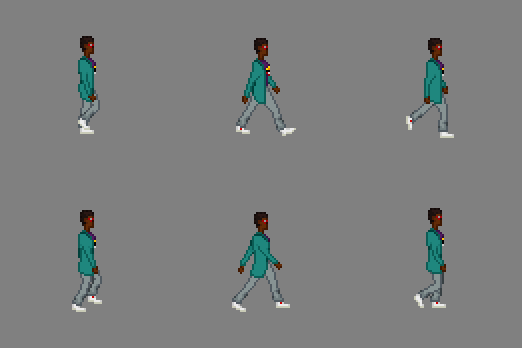
It’s likely not a process I’ll be able to use for every animation (CMU’s database, while extensive, still has some limits to its captured movements, and so far “monster fighting” isn’t among them), but I’m pleased with the results thus far. And hopefully staring at frame after frame after frame of human locomotion will give me a little better understanding when I need to wing it in the future.
* If you’re interested in further information about the making of Prince of Persia, I highly recommend Jordan Mechner’s own journals, which provide a contemporaneous account of its creation that I found incredibly interesting and inspiring in my own development as a creator.
† Dear reader, I know you probably already knew this was called rotoscoping. I wasn’t trying to pretend I was better than you. I put on my pants one devlog post at a time, just like anyone.
 Terror High